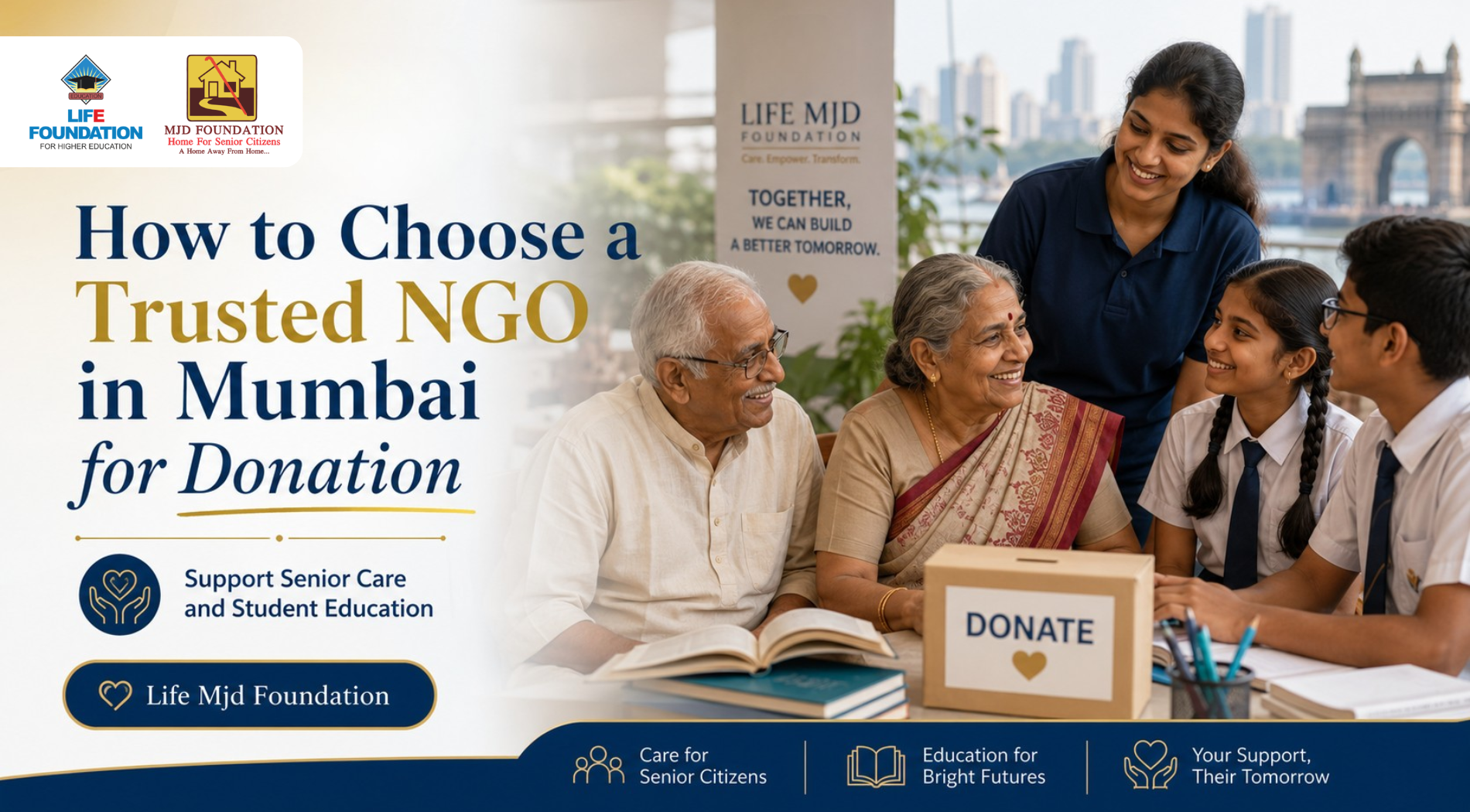
Many people want to support a meaningful cause but pause before making a payment. They wonder whether the organisation is genuine, how their money will be used and whether they will receive a proper acknowledgement.
These questions are not signs of distrust. They are signs of responsible giving.
Choosing the right NGO in Mumbai is not about finding the organisation with the loudest campaign or the biggest social media following. It is about finding a cause that matters to you and an organisation that can clearly explain what it does, whom it supports and how donors can participate.
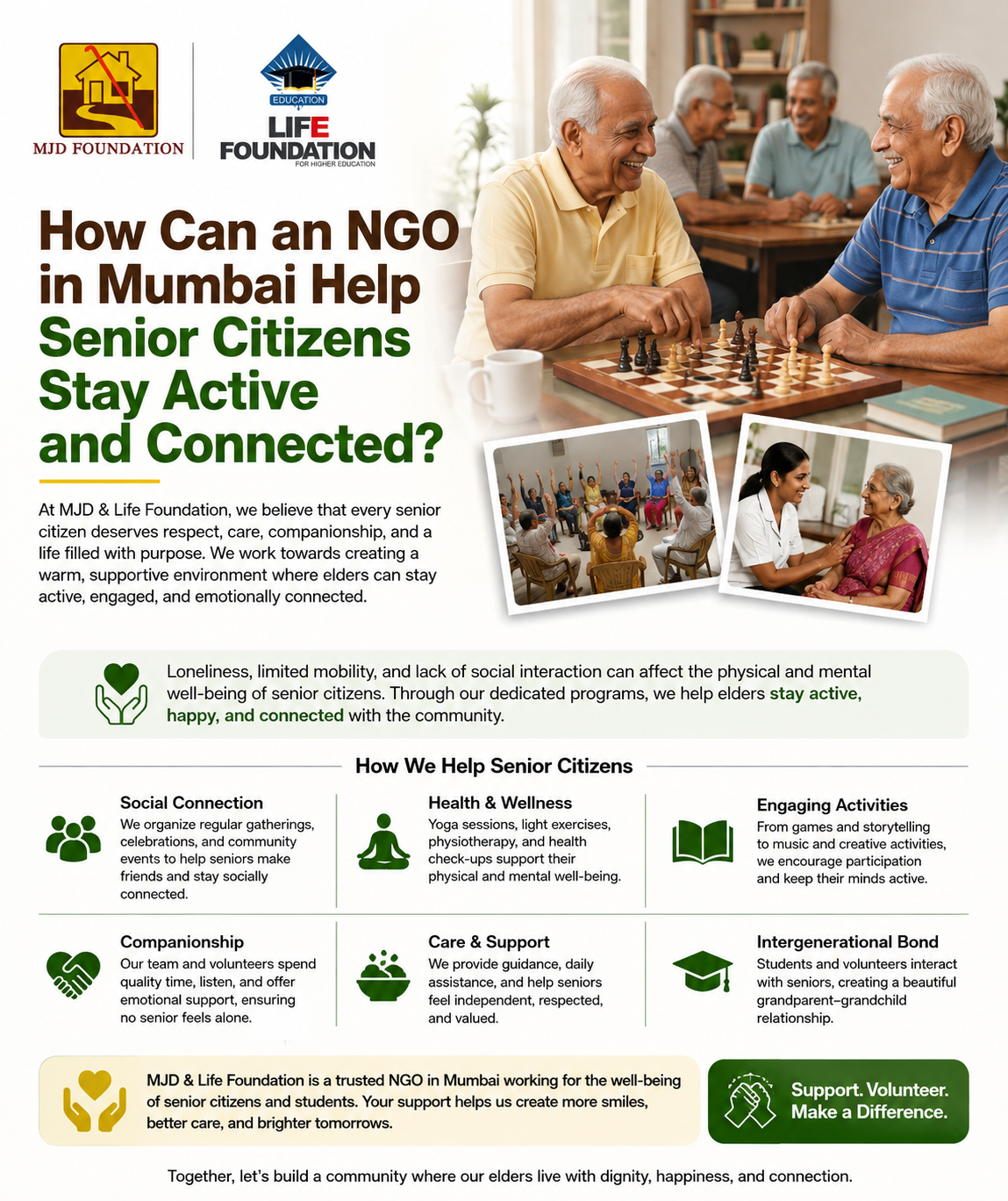
Life MJD Foundation, also known as MJD & Life Foundation, works with two groups that often need sustained community support: senior citizens and students pursuing education. Its model brings elderly care, education, mentorship and intergenerational community-building together.
Quick answer: A trustworthy NGO should have a clear mission, identifiable leadership, recent programme evidence, verifiable contact details, safe payment instructions and a reliable receipt process. Before donating, confirm the cause, ask how funds will be used and verify any tax-benefit claim separately.
What makes an NGO in Mumbai worth supporting?
A worthwhile NGO in Mumbai addresses a genuine community need through structured, consistent and respectful programmes. It should be able to show what it does, who manages the work, how donors can contact the organisation and what evidence is available. Emotional stories matter, but trust also requires clear processes.
There is no single organisation that can objectively be called the “best NGO” for every donor.
One person may care deeply about higher education. Another may want to improve the daily life of senior citizens. A company may want to support health, food, skills or community welfare through its CSR programme.
The right organisation is the one that offers a credible match between:
- The cause you value
- The people you want to support
- The type of contribution you can make
- The evidence you need before donating
- The communication you expect afterwards
A donor should therefore replace the question “Which is the best NGO?” with a better question:
“Which organisation is best suited to the cause, level of involvement and accountability I expect?”
Why should donors consider supporting a local NGO?
Supporting a local organisation can make participation more personal. Donors may be able to speak with the team, understand current programme needs, attend an event, volunteer or see how the organisation serves its community. Local support can also strengthen long-term relationships rather than creating a one-time financial transaction.
A local charity NGO in Mumbai may understand practical issues that are specific to the region, such as:
- High education and travel costs
- Limited access to career guidance
- Loneliness among elderly people
- Need for regular health and wellness activities
- Difficulty sustaining nutritious meals and daily programmes
- Lack of safe spaces for community participation
Local giving does not automatically mean better giving. A nearby organisation still needs to be verified.
However, proximity can make responsible participation easier. A donor may begin with a modest contribution, review updates and gradually build a longer relationship with the organisation.
What should you check before donating to an NGO?
Before donating, examine the organisation’s purpose, leadership, activities, documentation, payment process and communication. A genuine organisation should welcome reasonable questions. The goal is not to demand private beneficiary information; it is to confirm that the organisation operates responsibly and treats both donors and beneficiaries with respect.
1. Does the NGO clearly explain its cause?
A credible organisation should state exactly whom it supports and what programmes it conducts. Broad phrases such as “helping humanity” are not enough on their own. Look for specific services, target groups, locations and examples of recent work before making a financial commitment.
Check whether the NGO explains:
- Who receives support
- How beneficiaries are selected
- Whether help is short-term or continuing
- What programmes are currently active
- Where activities take place
- What donors can sponsor
- Whether contributions may be allocated to the area of greatest need
Life MJD Foundation presents two main areas of work. MJD Foundation focuses on helping senior citizens live meaningful, joyful and dignified lives, while LIFE Foundation supports students through education, skills and personal development.
2. Can you identify the organisation and its leadership?
A trustworthy NGO should make its official name, location, contact information and leadership reasonably easy to find. Donors should also check whether trustees, programme heads or responsible contact persons are publicly identified. Anonymous leadership and constantly changing payment details deserve additional scrutiny.
Useful trust signals include:
- Legal name of the organisation
- Registered office or operating address
- Names of trustees or directors
- Working telephone number and official email
- Public programme pages
- Recent photographs and updates
- Registration or approval documents where relevant
- Financial reports or utilisation summaries
- Privacy and refund policies
Life MJD Foundation publishes information about its founding trustees and lists its address and contact details on its official website. Its listed location is in Virar West, Maharashtra, so donors planning a visit should confirm directions and visiting arrangements directly with the organisation.
The NPO Darpan portal may also help donors check organisational information. However, NITI Aayog states that a Darpan ID is based on submitted information and does not itself constitute an endorsement or official recognition of the organisation’s quality.
3. Does the NGO show recent programme activity?
Recent activity is more useful than a long list of old promises. Look for dated events, programme photographs, beneficiary-safe stories, workshop reports and recurring service updates. A single annual celebration should not be the only evidence of an organisation’s work.
Life MJD Foundation’s published activities include senior wellness support such as physiotherapy, yoga and medical check-ups. Its education work includes scholarships, mentoring, resources and personal-development activities. The Foundation reports that LIFE Foundation supports more than 100 students annually and has provided more than 500 scholarships since its inception.
When reviewing impact claims, ask:
- Is the reporting period stated?
- Is the programme still active?
- Are numbers explained clearly?
- Are photographs recent?
- Is beneficiary dignity protected?
- Is there evidence beyond generic stock images?
- Can the organisation explain how it measures progress?
4. Is the donation process clear and secure?
A safe donation process should tell you the official account name, accepted payment methods, information required for acknowledgement and whom to contact if a payment fails. Never transfer money only because payment details appeared in a forwarded message or an unverified social media comment.
Before paying:
- Visit the organisation’s official website.
- Confirm the official account or payment page.
- Match the account name with the organisation.
- Avoid transferring to an unexplained personal account.
- Save the transaction reference number.
- Submit accurate donor details.
- Request an acknowledgement.
- Contact the organisation if payment confirmation does not arrive.
Life MJD Foundation’s official pages allow donors to select either MJD Foundation or LIFE Foundation and indicate whether their support is one-time or recurring. The organisation also presents opportunities to contribute towards a student’s education, a senior’s living needs or a meal.
Warning: Payment details may change. Always verify them on the official website or directly with the organisation immediately before transferring money.
5. Does the NGO explain how donations are allocated?
An organisation should distinguish between restricted and unrestricted contributions. A restricted donation is intended for a selected programme, while an unrestricted contribution may be used where the need is greatest. Both can be valuable, but the donor should understand the difference before paying.
Questions worth asking include:
- Can I select education or senior care?
- Can I sponsor a specific programme rather than an individual?
- Will unused restricted funds be reallocated?
- Are administrative and programme costs explained?
- Can I receive an utilisation update?
- What happens when a programme is fully funded?
Do not demand personal records or direct access to vulnerable beneficiaries. Responsible transparency must protect the dignity and privacy of the people receiving support.
6. Is the donation eligible for an 80G deduction?
An NGO donation is not automatically eligible for an income-tax deduction. Donors must verify that the recipient had valid approval for the relevant period and determine which deduction category applies. They should also request the appropriate receipt and donation certificate instead of relying on a promotional claim.
The Income Tax Department advises donors to verify the organisation’s current approval and obtain Form 10BE where applicable. It also states that a deduction is not available for cash donations exceeding ₹2,000 and that Section 80G cannot be claimed under the new tax regime. Donor details must match the information reported by the organisation.
Before claiming a deduction, confirm:
- The organisation’s current 80G approval
- The applicable deduction category
- Official donation receipt
- Name and PAN of the donee
- Registered address
- Approval or registration number
- Donation amount
- Form 10BE, where applicable
- Accuracy of your PAN and other donor details
Do not assume that Life MJD Foundation’s donation is tax-deductible merely because it is a charitable organisation. Ask the Foundation for its current approval details and consult a qualified tax professional when the deduction matters.
How does Life MJD Foundation support two generations?
Life MJD Foundation in mumbai works through a two-generation model. MJD Foundation focuses on senior citizens, while LIFE Foundation supports education and youth development. Instead of treating old age and youth as unrelated causes, the organisation creates opportunities for seniors and students to participate in one community.
| Area | Type of support |
|---|---|
| Senior care | Meals, wellness, health support, physiotherapy, yoga, companionship and activities |
| Student education | Scholarships, educational resources, mentoring and academic guidance |
| Skill development | Communication, career awareness, practical learning and personal development |
| Community | Shared celebrations, volunteering and intergenerational interaction |
| Donor participation | Education support, senior support, meal contribution and recurring giving |
The Foundation describes its approach as a grandparent–grandchild culture in which seniors and students connect like family. Its stated purpose is to help seniors retain dignity and independence while helping students access education and professional guidance.
Supporting senior citizens with dignity
An effective NGO for senior citizens in Mumbai should provide more than occasional entertainment. Senior well-being can require consistent meals, physical activity, medical attention, personal care, companionship and a sense of belonging. The exact support should be based on each programme’s scope and professional guidance.
Life MJD Foundation publishes updates about:
- Routine health check-ups
- Physiotherapy sessions
- Yoga and wellness activities
- Nutritious meals
- Grooming and personal-care activities
- Social and cultural engagement
- Companionship and community participation
These programmes are intended to help senior members feel cared for, respected and involved in daily life.
Helping students continue higher education
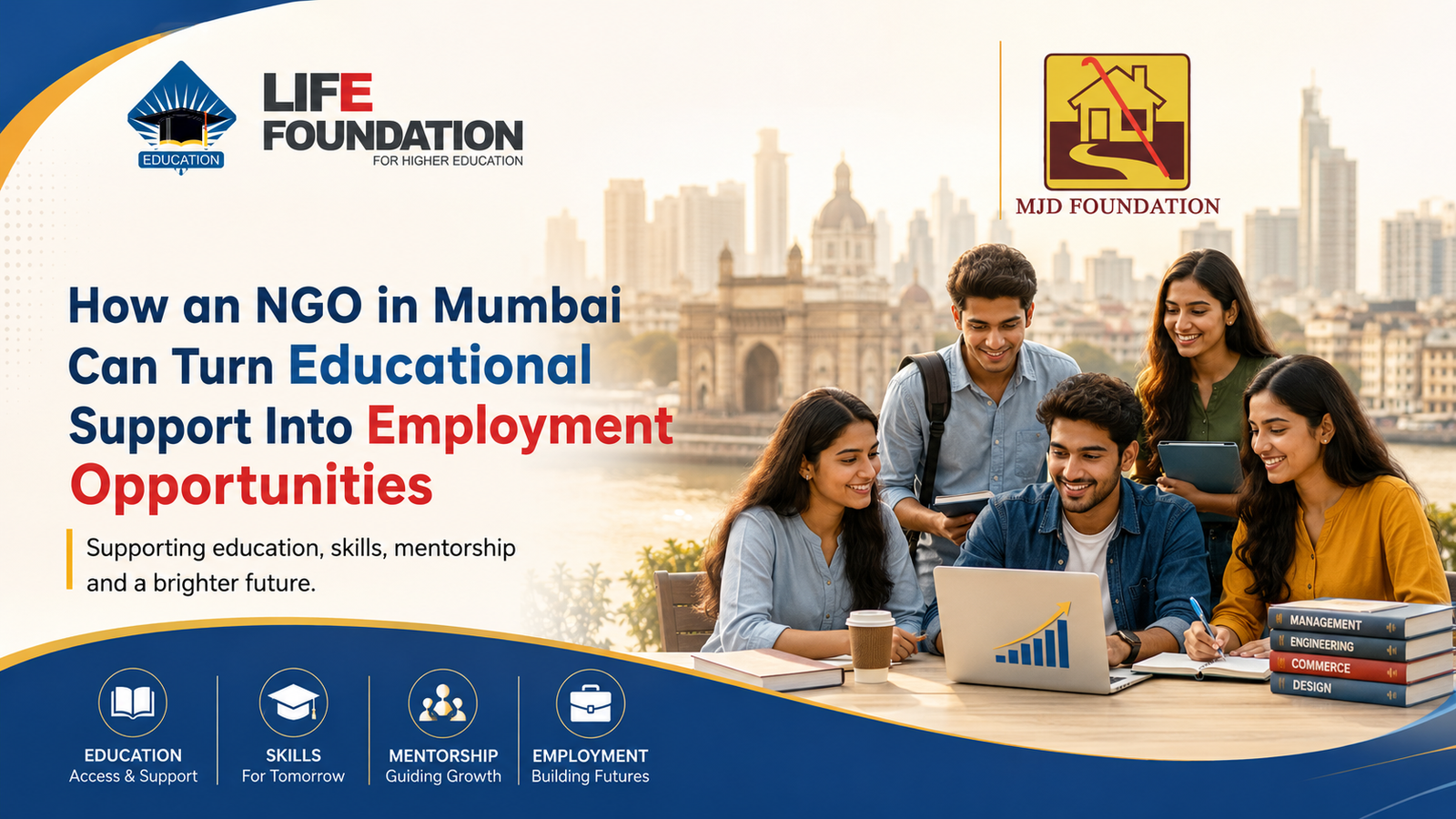
A responsible education NGO in Mumbai should look beyond paying one fee. Students may also need mentoring, learning resources, career guidance, communication skills and emotional encouragement. Long-term support can help a learner move from admission to graduation and eventually towards employment.
LIFE Foundation states that it offers:
- Scholarships
- Mentorship
- Educational resources
- Skill-development activities
- Career guidance
- Community support
- College and professional-course pathways
The Foundation reports more than 500 scholarships and ongoing annual support for over 100 students. Its published student stories describe educational progression, professional mentoring and career development.
Creating an intergenerational community
An intergenerational programme allows seniors and students to contribute to each other’s lives. Seniors can share experience, stories and values, while students can offer companionship, energy and practical support. The result is not simply two programmes operating under one roof; it is a community built across age groups.
This model may help:
- Reduce feelings of isolation
- Encourage empathy
- Give seniors a stronger sense of purpose
- Give students access to guidance and life experience
- Create shared cultural and community activities
- Turn beneficiaries into active community contributors
How can a donation support Life MJD Foundation’s work?
A contribution may support education, senior wellness, meals, learning resources, mentoring or general programme continuity. The exact use depends on current needs and whether the donation is restricted. Donors should avoid assuming that a fixed amount always produces a fixed result unless the organisation publishes a current cost breakdown.
| Donation preference | Possible area of support |
| Student education | Fees, learning resources, academic assistance or mentorship |
| Senior citizen care | Meals, wellness activities, comfort and daily programmes |
| Health and wellness | Check-ups, physiotherapy, yoga or related activities |
| Meal contribution | Breakfast, lunch, dinner or nutritional support |
| Skill development | Workshops, career sessions and practical learning |
| Unrestricted support | The programme area with the most immediate need |
The word “possible” is important. Programme costs change, and the Foundation should confirm current requirements before a donor promises a specific outcome.
A useful question is:
“What is the most urgent programme need this month, and how will my contribution be allocated?”
Is a one-time or monthly donation better?
A one-time donation is useful for immediate support, special occasions and first-time donors. A monthly contribution can help an NGO plan recurring programmes with greater consistency. Neither option is universally better; the right choice depends on your budget, level of trust and desired involvement.
| Factor | One-time donation | Monthly donation |
| Commitment | Single contribution | Ongoing contribution |
| Best for | First-time donors or special occasions | Donors seeking sustained impact |
| Budget control | Chosen once | Requires regular budget review |
| NGO planning | Helps a current need | Supports predictable planning |
| Flexibility | No future payment | Donor should understand cancellation process |
| Engagement | May be occasional | Can support regular updates and involvement |
A practical approach is to begin with a one-time donation, review the acknowledgement and programme communication, and then consider recurring support.
Monthly giving should never create financial stress. A modest, sustainable amount is usually more responsible than an ambitious amount that must be stopped immediately.
How much should you donate?

There is no universally correct donation amount. A responsible contribution is one that fits your budget, supports a cause you value and does not create personal financial difficulty. The meaning of a donation comes from its purpose and consistency not from comparing it with another donor’s amount.
Use this simple framework:
Step 1: Set a comfortable annual giving budget
Decide how much you can donate during the year after meeting essential personal and family expenses.
Step 2: Select one or two causes
Dividing a small budget among too many organisations may make it difficult to build meaningful engagement.
Step 3: Ask about current needs
The organisation may need educational resources one month and senior wellness support the next.
Step 4: Decide between fixed and flexible support
Choose whether the contribution must be used for one programme or may be allocated where needed.
Step 5: Review your giving annually
Check your budget, the organisation’s updates and whether the cause still matches your priorities.
How can you donate safely to Life MJD Foundation?
The safest method is to begin from the Foundation’s official website, select the appropriate programme, verify payment information and retain the transaction reference. Donors should provide accurate contact and tax information and request clarification before paying whenever instructions are incomplete.
Donation steps
- Visit the official Life MJD Foundation website.
- Review the MJD and LIFE Foundation programme pages.
- Choose senior care, education, meals or general support.
- Decide whether the donation is one-time or recurring.
- Confirm the official payment details.
- Enter your name, contact details and PAN accurately where required.
- Complete the payment.
- Save the transaction reference and screenshot.
- Request or download the acknowledgement.
- Ask about Form 10BE separately when claiming an eligible deduction.
- Subscribe to programme updates only when you consent to receive them.
- Contact the Foundation if confirmation is delayed.
Which donation option should you choose?
Choose senior care when your priority is elderly dignity and wellness. Choose education when you want to support students’ academic and career journey. Select meal support for a focused act of giving. Choose unrestricted support when you trust the organisation to address its most urgent programme need.
Simple decision tree
- They you want to support a particular cause?
- Yes, senior citizens: Choose MJD Foundation or a senior-care programme.
- Yes, education: Choose LIFE Foundation or a student-support programme.
- Yes, meals: Ask about current meal-sponsorship requirements.
- No specific cause: Consider unrestricted support.
Do you want to contribute regularly?
- No: Select a one-time donation.
- Yes: Ask about monthly giving and cancellation instructions.
Do you need a tax deduction?
- No: Keep the payment acknowledgement for your records.
- Yes: Verify current approval and documentation before donating.
What mistakes should donors avoid?
The most common mistakes are sending money to unverified payment details, assuming every contribution qualifies for 80G, focusing only on emotional content and failing to save records. Responsible donors balance compassion with basic verification and never pressure themselves into an unaffordable commitment.
Avoid these mistakes:
- Donating through an unofficial personal message
- Ignoring the account name
- Believing an outdated 80G claim
- Paying cash when documentation matters
- Entering the wrong PAN
- Expecting private beneficiary information
- Measuring impact only through social media followers
- Assuming administration costs should always be zero
- Making a recurring commitment without reading the process
- Forgetting to save the transaction reference
- Demanding a guaranteed individual outcome
- Donating more than your budget permits
Expert note: Reasonable operating costs are part of running programmes safely. Evaluate whether expenses are explained and proportionate rather than assuming every non-programme expense is wasteful.
What should a first-time donor ask?
A first-time donor should ask about the programme, current needs, payment method, receipt, tax documentation, communication and privacy. These questions protect the donor while also helping the organisation understand what type of relationship the supporter expects.
First-time donor checklist
- I understand the organisation’s mission.
- I know which programme I am supporting.
- I have checked recent programme updates.
- I have verified the official payment channel.
- I understand whether my donation is restricted.
- I know what acknowledgement I will receive.
- I have confirmed current 80G details where relevant.
- I have entered my contact and PAN information accurately.
- I have saved the transaction reference.
- I know whom to contact with a question.
- The donation fits comfortably within my budget.
- I understand how my data may be used.
What are realistic ways people can support the Foundation?
Support does not have to begin with a large transfer. A donor may sponsor part of an educational programme, contribute towards a senior activity, help with a meal, volunteer professional skills or make a modest recurring contribution. The most useful option depends on the Foundation’s current needs.
Scenario 1: A first-time individual donor
A Mumbai professional wants to support education but has never donated to an NGO. She reviews the LIFE Foundation page, asks about current student needs, makes a comfortable one-time contribution and saves the acknowledgement. After receiving programme updates, she considers monthly support.
Scenario 2: A family celebrating an occasion
A family wants to celebrate a birthday through service. Instead of assuming a menu or cost, they contact the Foundation, ask what meal or senior activity is currently needed and arrange the contribution through official channels.
Scenario 3: A company seeking community involvement
A local company wants its employees to participate in education and senior care. It first checks the Foundation’s legal and CSR documentation, agrees on a defined programme, establishes reporting expectations and combines financial support with employee volunteering.
These scenarios are examples, not descriptions of guaranteed programme arrangements. Every donor should confirm current availability directly with the Foundation.
What should happen after you donate?
After payment, you should retain the transaction record and receive an acknowledgement from the organisation. Where tax eligibility applies, request the required certificate. Over time, a responsible NGO should share suitable programme updates without exposing private beneficiary details or overwhelming donors with repeated requests.
Your post-donation actions should include:
- Check that the payment was completed.
- Save the acknowledgement and receipt.
- Verify that your name and PAN are correct.
- Request Form 10BE when applicable.
- Add the organisation’s official contact to your records.
- Review future programme updates.
- Inform the NGO if you do not want promotional communication.
- Reassess recurring giving annually.
- Report any suspicious message pretending to represent the organisation.
- Share verified programme information responsibly.
Can businesses support Life MJD Foundation through CSR?
Businesses may support eligible NGOs through CSR only after completing the required legal and compliance checks. A company should verify the proposed project, implementing entity, CSR registration status where applicable, budget, reporting process and measurable outcomes before treating a donation as CSR expenditure.
Under the CSR rules, eligible implementing entities undertaking CSR activities generally need to file Form CSR-1 and receive a CSR registration number. Corporate donors should obtain current documentation and advice from their compliance professionals rather than assuming that an ordinary donation automatically qualifies as CSR expenditure.
A corporate due-diligence request may include:
- Legal registration documents
- PAN
- Current tax registrations
- CSR-1 details where applicable
- Trustee or director information
- Audited financial statements
- Project proposal
- Budget and timeline
- Monitoring plan
- Utilisation reporting
- Safeguarding and privacy practices
This section does not confirm Life MJD Foundation’s present CSR eligibility. Companies should verify it directly.
Why consider Life MJD Foundation for your donation?
Life MJD Foundation may suit donors who want to support two connected causes: helping senior citizens live with dignity and helping students continue their education. Its programmes include senior wellness activities, scholarships, mentoring, learning resources and opportunities for community participation.
Its distinctive value lies in the relationship between generations.
A donation can support people at two important stages of life:
- Seniors who deserve care, respect and belonging
- Students who need education, guidance and opportunity
The Foundation’s public information shows an established education programme, senior wellness activities, trustees, student stories and donation options. Donors should still complete their own verification, particularly when tax benefits, CSR treatment or restricted funding are important.
Support education, senior care and dignity

Choosing an NGO in Mumbai for donation should never feel like an impulsive transaction. Take time to understand the cause, verify the organisation, select a comfortable amount and keep the required documents.
Through Life MJD Foundation, donors can explore support for:
- Senior citizen care
- Health and wellness activities
- Nutritious meals
- Higher education
- Scholarships
- Student mentoring
- Skills and career development
- Intergenerational community programmes
Visit the Foundation’s official website, review its current programmes and contact the team to confirm the most urgent need before making your contribution.
A thoughtful donation does more than transfer money. It tells a senior citizen that they are valued and reminds a student that their future matters.
Frequently Asked Questions
1. Which NGO in Mumbai supports both students and senior citizens?
Life MJD Foundation works through MJD Foundation for senior care and LIFE Foundation for education and youth development. Donors should review the current programmes and decide whether they want to support one cause or the organisation’s broader work.
2. How do I choose a trusted NGO in Mumbai?
Check the mission, leadership, legal identity, address, recent activities, payment process and documentation. Speak with the organisation before donating when information is unclear, and never rely only on a forwarded payment message.
3. Can a small donation make a difference?
Yes. Small contributions can collectively support meals, educational resources, activities and programme continuity. The organisation should avoid promising a fixed outcome unless it has published a current and accurate cost breakdown.
4. Is a monthly donation better than a one-time donation?
Monthly giving can help an NGO plan recurring programmes, while one-time giving offers greater flexibility. Begin with the option that fits your budget and level of confidence in the organisation.
5. Can I choose how my donation is used?
Many NGOs allow donors to select a programme, but policies differ. Ask whether the contribution is restricted to one cause or may be used where the need is greatest.
6. Can I donate specifically to MJD Foundation?
The Foundation’s donation form allows donors to select MJD Foundation. Confirm the current senior-care programme and official payment details before transferring money.
7. Can I donate specifically to LIFE Foundation?
Yes. The official donation form includes LIFE Foundation as a selection. Donors may contact the team to ask whether education, scholarships, resources or mentoring currently need support.
8. Does Life MJD Foundation support student education?
LIFE Foundation publishes programmes involving scholarships, educational resources, mentorship and skill development. It reports supporting more than 100 students annually.
9. What senior-care activities does MJD Foundation conduct?
Published activities include physiotherapy, yoga, health check-ups, meals, grooming and social engagement. Programme frequency and availability should be confirmed directly because schedules may change.
10. Can I sponsor a meal for senior citizens?
The Foundation presents meal contribution as one way to participate. Contact the organisation to confirm the date, current need, menu arrangements, cost and payment process.