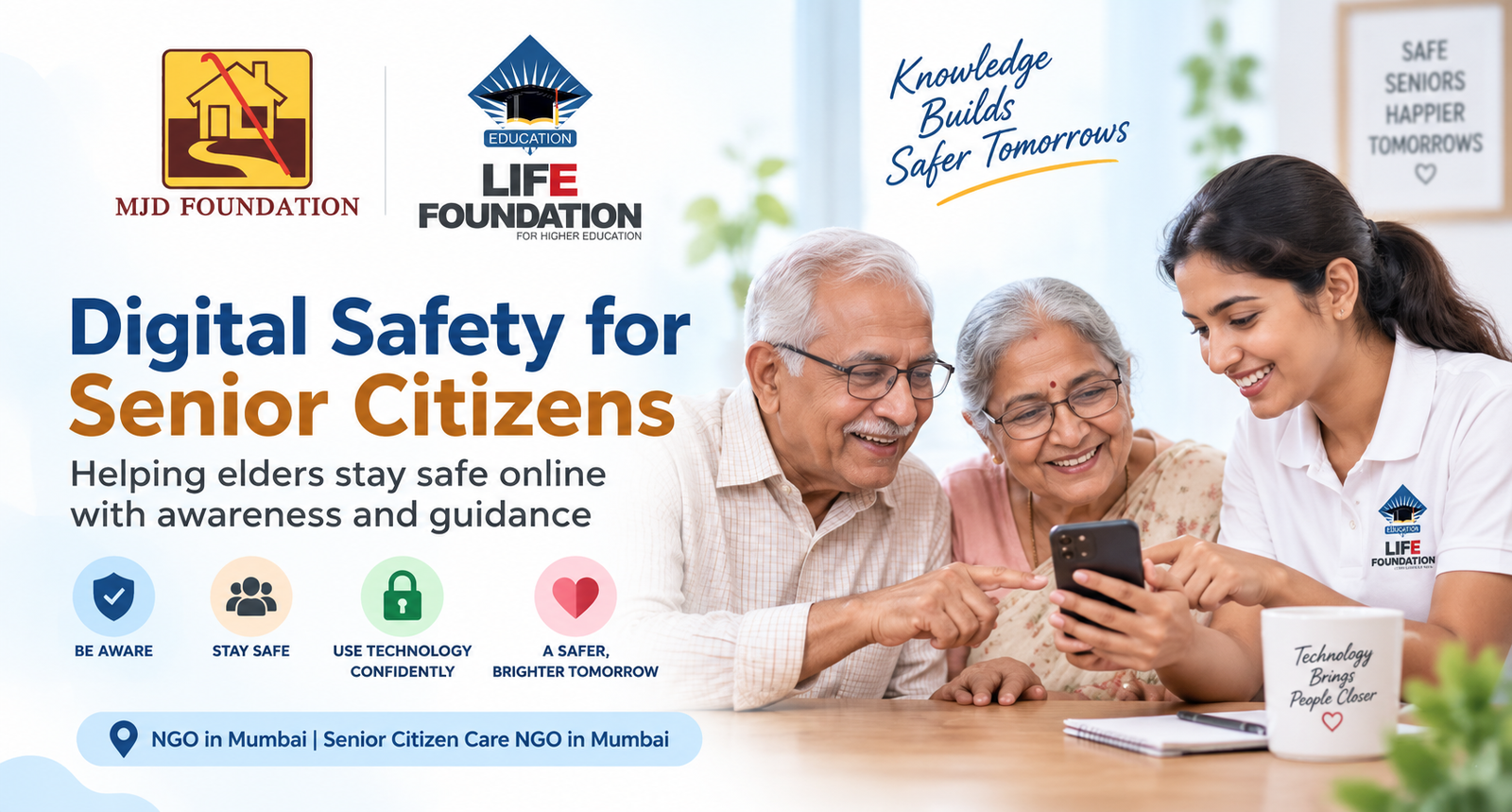
For senior citizens, using smartphones and online services has become part of everyday life. But with that convenience comes the risk of fake calls, phishing links and digital fraud. This is why NGO in Mumbai Help Senior Citizens Stay Safe is becoming increasingly important, especially for elders who may not always recognise new types of online scams.
A call that sounds official may be fake. A WhatsApp message may contain a dangerous link. Someone claiming to be from a bank, police department or government agency may create fear and ask for money. For an older person who is less familiar with changing digital technology, knowing what is genuine is not always easy.
This is where an NGO in Mumbai can play an important role. Along with health, companionship and social support, senior care can also include practical digital awareness.
A Senior Citizen Care NGO in Mumbai can help elders understand common scams, recognise warning signs and know what to do before responding to a suspicious message or call. Just as importantly, seniors need to feel comfortable asking for help without feeling embarrassed.
Digital safety is no longer only a technology issue. It is part of helping older adults remain independent, informed and confident.
How Can an NGO in Mumbai Help Senior Citizens Stay Safe Online?
An NGO in Mumbai can help senior citizens stay safe from online scams by teaching them how to identify suspicious calls, fake links, phishing messages and payment fraud. NGOs can also conduct digital-awareness sessions, encourage safe banking habits, involve family members and explain how to report cyber fraud quickly through India’s cybercrime helpline 1930.
What Is Digital Safety for Senior Citizens?
Digital safety for senior citizens means helping older adults use smartphones, banking apps, social media, WhatsApp, email and online services without unknowingly sharing sensitive information or becoming victims of fraud.
It does not mean asking elders to stop using technology.
The goal is quite the opposite: help them use technology with more confidence.
For example, imagine an elderly person receives a call saying, “Your bank account will be blocked today unless you verify your details.” The caller knows the person’s name and speaks professionally.
Would most people immediately know whether the call is genuine?
Digital awareness teaches seniors to slow down, verify the claim independently and never share an OTP, PIN, password or banking credential simply because someone sounds convincing.
A Senior Citizen NGO in Mumbai can make these lessons easier by explaining them in familiar language, repeating important safety habits and using real-world examples rather than technical jargon.
Digital safety is not about making senior citizens afraid of technology. It is about helping them pause, verify and use digital services more confidently.
Why Is Digital Safety Important for Senior Citizens?
Cyber fraud is not a small or isolated problem.
Government data shows that more than 24 lakh financial cyber-fraud complaints were reported through India’s National Cyber Crime Reporting Portal in 2025, involving more than ₹22,495 crore in reported amounts. The figures cover people across age groups, but they show the scale of the wider online-fraud problem.
Senior citizens may face additional challenges because scammers often use urgency, authority and fear rather than sophisticated technology.
Common risks include:
- Fake bank calls: Fraudsters may claim that an account, card or KYC needs urgent verification.
- OTP and UPI fraud: A caller may ask for an OTP, PIN or payment approval.
- Digital arrest scams: Criminals may pretend to be police, CBI or other government officials.
- Fake investment opportunities: Seniors may be promised unusually high or guaranteed returns.
- WhatsApp impersonation: Someone may pretend to be a relative asking for emergency money.
- Phishing links: Messages may imitate banks, courier companies, government departments or well-known brands.
- Remote-access scams: Fraudsters may persuade a person to install an app that gives them access to the phone.
- Fake customer-care numbers: Seniors searching online for support may accidentally call a fraudulent number.
One 2026 CBI case involved a senior citizen who was allegedly threatened through a so-called digital arrest scam and induced to transfer ₹25.65 lakh. The CBI has specifically advised citizens not to share bank details, passwords, OTPs or financial credentials with unknown or unverified callers.
That is why digital education deserves a place alongside other senior welfare initiatives.
How Can an NGO in Mumbai Help Senior Citizens Step by Step?
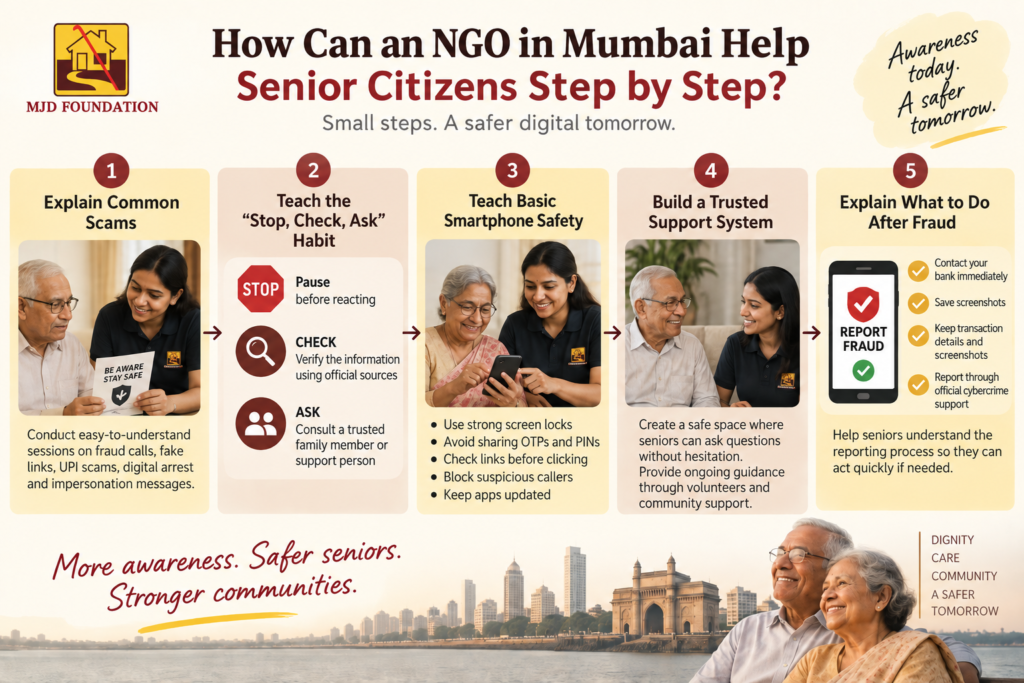
Digital safety becomes easier when it is taught through small, practical steps.
Step 1: Explain the most common scams
An NGO for senior citizens in Mumbai can conduct simple awareness sessions covering fraud calls, fake links, UPI scams, digital arrest threats and impersonation messages.
Instead of giving seniors a long list of technical terms, sessions can use familiar examples:
“Your SIM will be disconnected.”
“Your account has been linked to a criminal case.”
“Your KYC has expired.”
“Your son or daughter needs money urgently.”
Seeing these examples beforehand makes them easier to recognise later.
Step 2: Teach the “Stop, Check, Ask” habit
Before clicking a link or transferring money:
Stop. Check. Ask.
Pause before reacting.
Verify the information using an official number.
Ask a trusted family member, volunteer or support person if something feels unusual.
That short habit can create an important layer of protection.
Step 3: Teach basic smartphone safety
Workshops can explain how to:
- Use strong screen locks
- Avoid sharing OTPs and PINs
- Check links before clicking
- Block suspicious callers
- Review app permissions
- Avoid unknown screen-sharing applications
- Update phones and important apps
- Use only verified banking and payment applications
Step 4: Build a trusted support system
Sometimes an elder suspects something is wrong but hesitates to call a family member because they fear being judged.
A supportive community can change that.
A senior should feel comfortable saying, “I received this message. Can you check it for me?”
There should be no embarrassment in asking.
Step 5: Explain what to do after fraud
If financial cyber fraud occurs, speed matters.
India’s 1930 cybercrime helpline is available for reporting financial cyber fraud and assistance with lodging complaints. The Ministry of Home Affairs states that its financial cyber-fraud reporting system had helped save more than ₹11,158 crore across more than 32.80 lakh complaints by June 30, 2026.
Knowing the reporting process before something happens can prevent panic later.
Effective digital safety training should teach seniors three things: how to recognise a scam, how to verify suspicious communication and where to report fraud quickly.
What Are the Benefits of Digital Safety Programs for Senior Citizens?
A well-designed awareness program can offer several benefits:
- Greater confidence: Seniors can use smartphones and online services with less fear.
- Better fraud awareness: Common warning signs become easier to recognise.
- Safer digital payments: Elders learn why OTPs, UPI PINs and passwords must remain private.
- Faster response: Seniors know whom to contact when something suspicious happens.
- More independence: They can continue using digital tools instead of avoiding them completely.
- Reduced isolation: Digital confidence can help seniors stay connected to friends and family.
- Better family communication: Family members and caregivers can follow the same safety rules.
Most importantly, seniors begin to understand that receiving a scam message is not a reason to panic.
The safest response is often simply to stop and verify.
NGO Digital Awareness vs Learning Online Alone: What Is the Difference?
| Area | NGO-Based Digital Awareness | Learning Alone Online |
|---|---|---|
| Personal guidance | Can provide human support | Usually self-directed |
| Language | Can be simplified and explained | May contain technical terms |
| Questions | Seniors can ask directly | Answers may be difficult to verify |
| Real-life demonstrations | Possible during workshops | Limited |
| Repetition | Lessons can be reinforced | Depends on the learner |
| Emotional reassurance | Community support is available | May feel confusing or isolating |
| Scam examples | Can focus on relevant situations | Information may be scattered |
Online guides are useful, but many senior citizens benefit from having someone physically explain what a suspicious message looks like and what they should do next.
Human support matters.
Who Needs Digital Safety Awareness?
Digital safety education can benefit almost every senior who uses a mobile phone.
It may be especially useful for people who:
- Use UPI or mobile banking
- Receive pension or investment-related communication online
- Shop on websites or apps
- Use WhatsApp regularly
- Click links received through SMS
- Live independently
- Are unfamiliar with new digital features
- Depend on online customer-care services
- Frequently receive unknown calls
Families can benefit too.
Children and caregivers should know which scams are circulating and create simple family rules. For example, no major money transfer should be made after an unexpected phone call without first checking with another trusted person.
How Much Do Digital Safety Awareness Programs Cost?
The cost depends on how the program is organised.
An NGO may include awareness sessions as part of broader senior citizen programs or conduct workshops with volunteers, banks, cyber-safety professionals or community partners.
Possible costs can include:
- Training materials
- Digital literacy workshops
- Expert sessions
- Printed safety guides
- Volunteer training
- Devices or internet access
- Community outreach activities
People searching for an NGO in Mumbai for Donation can consider supporting programs that improve senior welfare, independence, education and awareness.
Donations should always be made through verified organisational channels rather than payment links received from unknown messages.
What Are the Senior Digital Safety Trends in 2026?
Cybercrime awareness is becoming increasingly important as scams become more convincing.
In 2026, one major concern is the use of artificial intelligence, manipulated documents and realistic impersonation techniques. The CBI noted when launching its ABHAY notice-verification initiative in May 2026 that AI and deepfakes are making it harder for ordinary citizens to distinguish genuine communication from fabricated material.
Another growing concern is the so-called digital arrest scam.
Fraudsters may appear on video calls, use official-looking documents and pretend to represent law-enforcement agencies. Their main weapon is often fear.
This makes one lesson especially important for senior citizens:
Do not make an immediate financial decision because someone on the phone is threatening or pressuring you.
Technology will continue changing. Digital-awareness programs therefore need to be ongoing rather than treated as a one-time lesson.
Why Choose MJD & LIFE Foundation in Mumbai?
MJD & LIFE Foundation in Mumbai works across two important areas: senior citizen welfare and education.
Through the MJD Foundation, the organisation focuses on helping seniors live a meaningful, joyful and dignified life. Its stated senior-support approach includes health programs, independence, social activities and lifelong learning.
This community-based environment can also create opportunities for practical digital-awareness conversations, helping seniors become more informed about the online world around them.
The Life Foundation focuses on education, scholarships, skill development and mentorship. The organisation states that it has awarded more than 500 scholarships.
This intergenerational approach is especially valuable. Younger people who are comfortable with technology can help seniors understand everyday digital tools, while seniors bring their experience and wisdom into the relationship.
For families looking for a Senior Citizen Care NGO in Mumbai, Senior Citizen NGO in Mumbai, Elderly care NGO in Mumbai or Senior citizen welfare foundation in Mumbai, MJD & LIFE Foundation focuses on dignity, community and continued engagement.
The organisation also works as an education NGO in Mumbai, supporting students and higher education. People looking to donate for student education in Mumbai, sponsor a student’s education in Mumbai or support a higher education support NGO in Mumbai can explore its education initiatives.
Similarly, searches such as child NGO in Mumbai or NGO in Mumbai for child education often come from people looking for meaningful ways to support education. MJD & LIFE Foundation’s education work is focused on helping students access higher education, skills and mentorship.
Senior welfare today is about more than physical care. Helping elders remain socially connected, digitally informed and confident can also support their independence and dignity.
FAQs
1. How can an NGO in Mumbai protect senior citizens from online scams?
An NGO in Mumbai can conduct digital-literacy workshops, explain common scams, teach safe online banking habits and help senior citizens understand how to verify suspicious calls or messages. NGOs can also encourage seniors to report financial cyber fraud quickly through the 1930 helpline.
2. What online scams should senior citizens be careful about?
Senior citizens should be cautious of fake banking calls, OTP requests, UPI fraud, digital arrest threats, fake investment schemes, suspicious WhatsApp messages, phishing links and callers asking them to install remote-access applications.
3. What should a senior citizen do after an online financial scam?
The person should contact their bank immediately and report financial cyber fraud through 1930 and the National Cyber Crime Reporting Portal. They should preserve messages, transaction details, phone numbers and screenshots that may help with the complaint process.
4. Why is digital literacy important for senior citizens?
Digital literacy helps senior citizens use smartphones, online banking, UPI, communication apps and internet services more safely. It also teaches them to recognise suspicious behaviour before sharing personal information or transferring money.
5. How can families and a Senior Citizen Care NGO in Mumbai work together?
Families can create simple verification rules while a Senior Citizen Care NGO in Mumbai can reinforce them through awareness sessions, practical demonstrations and community support. Seniors benefit most when they have trusted people they can contact before acting on a suspicious request.
Help Senior Citizens Stay Connected, Confident and Informed
A scam can begin with something as ordinary as a phone call.
But a little awareness can make that call easier to recognise.
MJD & LIFE Foundation believes senior citizens deserve a life built around dignity, companionship, independence and meaningful engagement. Supporting digital awareness can be another step toward helping elders participate confidently in an increasingly connected world.
If you are looking for an NGO in Mumbai, an NGO for senior citizens in Mumbai or an NGO in Mumbai for Donation, explore the work of MJD & LIFE Foundation and discover how community support can make everyday life safer and more meaningful for seniors.
Because helping an elder understand one suspicious call today may help them make a safer decision tomorrow.
For further details contact:
MJD & LIFE Foundation – NGO in Mumbai
Address: Meghani Apartment, Ground Floor C” Wing, Dist, opp. Viva College, Virar West, Maharashtra 401303
Phone: 088797 00220